Adapting Active Magnetic Bearings: Practical Engineering Insights for Modern Machinery Design
Active magnetic bearings (AMBs) deliver benefits such as oil‑free operation, zero mechanical wear, high rotational speeds, and exceptional controllability that make them a compelling choice for next‑generation rotating machinery. When designed and integrated correctly, AMBs simplify the overall system, reduce maintenance needs, and unlock performance levels that traditional bearing technologies struggle to reach.
Conventional bearing technology has its limitations. Rolling‑element bearings face speed and lifetime constraints. Fluid‑film bearings require complex lubrication systems and sealing arrangements, while introducing growing friction losses as the rotating speeds increase. Against this backdrop, AMBs offer a fundamentally different value proposition, one that becomes even clearer when examining practical integration topics.
The following sections walk through the key engineering considerations, highlight where competing technologies fall short, and show how AMBs overcome their own integration challenges with smart design choices.
Footprint Inside the Machine
Comparison of specific load capacities
Rolling‑element and fluid‑film bearings achieve high specific load capacities, but they do so at the cost of mechanical wear, lubrication dependency, and speed limitations. Their load capacity is tied to material stress limits or fluid‑film behavior, and increasing performance often means increasing complexity such as larger housings, more lubrication paths, or higher‑precision machining.
Table 1. Specific bearing loads for different bearing types (ISO 14839-4)

AMBs generate force magnetically, which inherently results in lower specific load capacity (typically 0.5–0.7 N/mm² radially). This means the machine must allocate more volume to the magnetic actuator and sleeve compared to traditional bearings.
AMBs generate force magnetically, which inherently results in lower specific load capacity (typically 0.5–0.7 N/mm² radially). This means the machine must allocate more volume to the magnetic actuator and sleeve compared to traditional bearings.
Engineering solution: system‑level optimization
Although the AMB unit may appear larger locally, the overall machine footprint can be optimized by leveraging AMB advantages:
- No lubrication channels or oil distribution features inside the bearing housing
- No need for seals to prevent oil ingress to process
- No need for seals to prevent process medium ingress to bearings
- Integrated sensors and safety bearings packaged efficiently around the rotor
- Higher allowable speeds enabling smaller rotating components elsewhere
The result is a bearing system that may be larger in component-focused comparison but contributes to a more compact and efficient machine architecture overall.
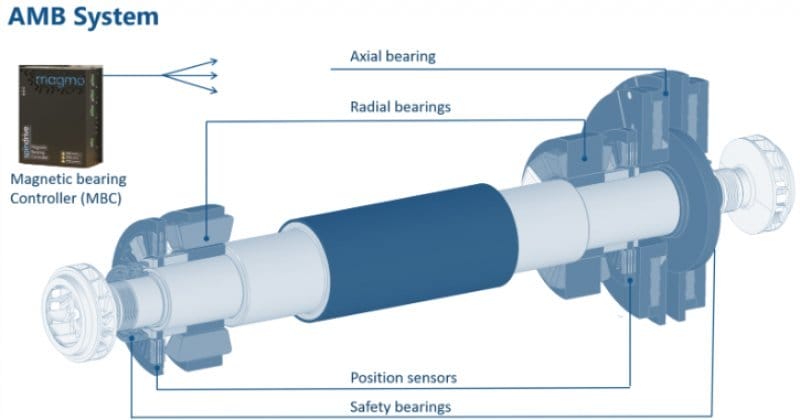
Figure 1. Key components of active magnetic bearings. The magnetic bearing controller would typically be placed in an enclosure with other electric components.
Footprint Outside the Machine
Where traditional bearings fall short
Fluid‑film and rolling‑element bearings require oil tanks, pumps, filters, coolers, emergency lubrication, and maintenance access. These ancillary systems often exceed the size of the bearing itself and introduce failure points, installation complexity, and operational cost.
AMBs need only a controller and UPS
AMBs require a magnetic bearing controller and, in many applications, an uninterrupted power supply (UPS). These are the only essential external components.
Engineering solution: dramatically simplified auxiliary systems
Compared to lubrication systems, the AMB controller is compact, clean, and easy to place. For example, a controller for the size of 400 × 400 × 160 mm like SpinDrive magma X800 can replace an entire lubrication system. In such cases, the volume occupied by the AMB controller is only a fraction of the oil lubrication system. With no oil handling, no contamination risk, and minimal maintenance, AMBs reduce the system‑level footprint and simplify installation and service.
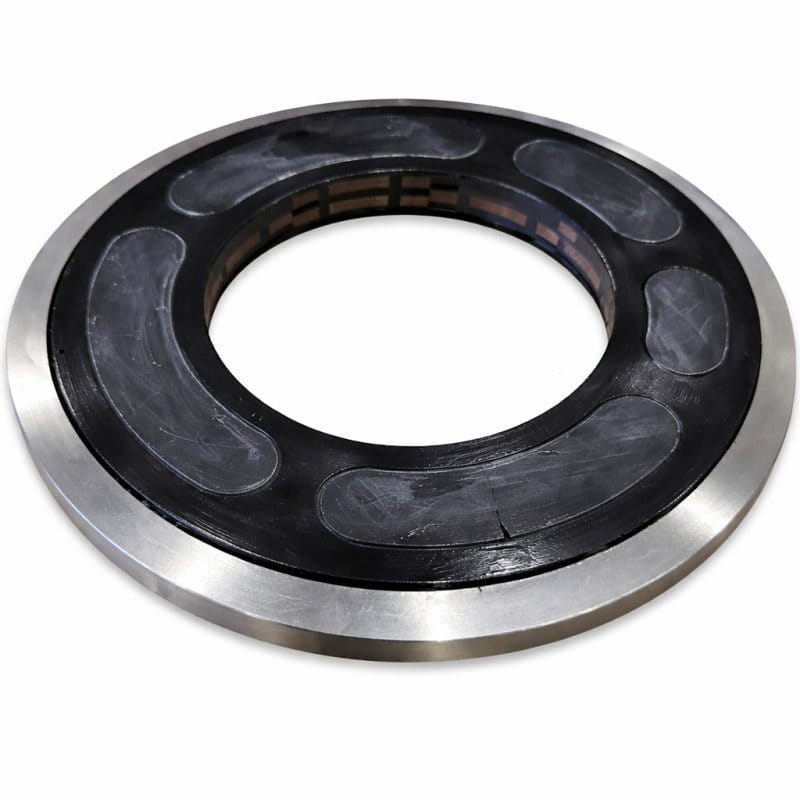
Figure 2. sessor part of the AMB system
Hermetic Barrier Placement
Where traditional bearings fall short
Conventional bearings require shaft seals to prevent oil leakage or process fluid ingress. These seals wear over time, require precise alignment, and often dictate maintenance intervals. In hermetic or leak‑tight applications, shaft seals become a major engineering and reliability challenge.
Clearances required for levitation
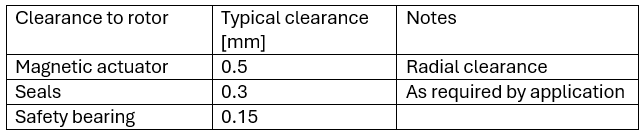
AMB operation requires radial clearances between the rotor, actuator, safety bearings, and any sealing components. Because seals must sit outside the safety bearing clearance, placing a hermetic barrier directly at the bearing becomes difficult.
Table 2. Typical radial clearances in machine with magnetic bearings.
Engineering solution: hermetic integration of the entire rotating assembly
The most robust approach is to place the entire rotating machine – driver and driven equipment – inside a single hermetic envelope. This eliminates shaft seals and uses only static seals at:
- Process piping
- Electrical feedthroughs for the motor and AMBs
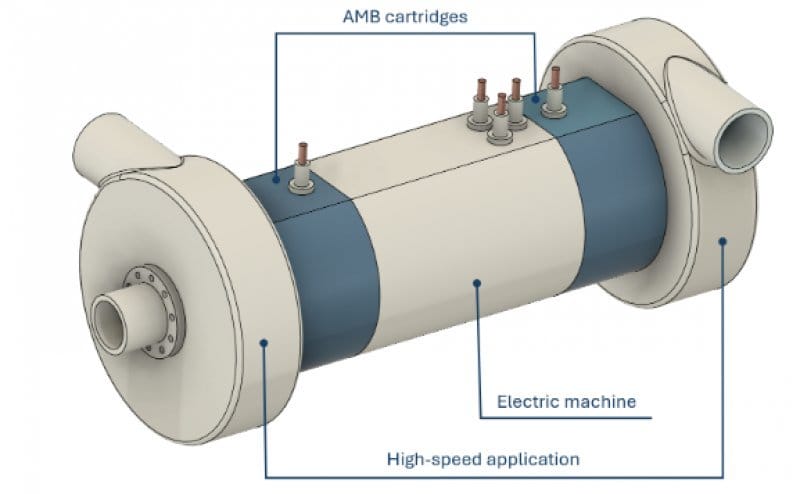
Figure 3. Application packaged to hermetic design. No shaft seals, only static seals at piping and electric feedthroughs.
This approach leverages AMB strengths: no oil, no contact, and no need for shaft sealing. It results in a clean, reliable, and maintenance‑free hermetic system.
Final Thoughts
Traditional bearings may appear compact, but their lubrication, sealing, and maintenance requirements expand the system’s footprint and introduce long-term operational challenges. In contrast, the total system footprint with AMBs can be 30–50% smaller when accounting for the elimination of lubrication infrastructure and the miniaturization of control electronics—with recent innovations reducing bearing actuator size by over 30% and controller volume by more than 90%.
Active magnetic bearings shift the paradigm. They may require slightly more axial space on the rotor, but they eliminate lubrication systems, remove shaft seals, reduce maintenance, and enable hermetic machine designs that are simpler, cleaner, and more reliable.
The SpinDrive team has deep experience in AMB system design, integration, and application engineering. If you are evaluating AMBs for your next machine—or want to understand how to overcome specific integration challenges—we are ready to support you with proven solutions and practical expertise.
Other blogs about active magnetic bearings
Interested in learning more about active magnetic bearings? Check other blogs about active magnetic bearing applications in various industries:
Active magnetic bearings for turbo blowers
Active magnetic bearings for turbo compressors
Active magnetic bearings for high-speed spindles
Why Magnetic bearings for high-speed applications?
Applications of active magnetic bearings
Benefits of active magnetic bearings

Author: Panu Hava