From Concept to Reality: The Role of Feasibility in Magnetic Bearing Design

At SpinDrive, we recognize that every active magnetic bearing (AMB) project has unique requirements and constraints. One of the services we offer to help customers evaluate their projects is the feasibility study—a structured analysis that assesses technical and operational viability before committing to full design and implementation.
What is a Feasibility Study?
A feasibility study provides a preliminary evaluation of an AMB application, examining key factors such as electromagnetic performance, rotor dynamics, and mechanical integration. It’s particularly useful for projects where operating conditions, space limitations, or performance requirements need careful upfront analysis. However, it’s not always necessary—many customers proceed directly to the design phase with well-defined parameters or directly to the AMB manufacturing.
The Strategic Value of a Feasibility Study
In our earlier blog, we mentioned the process of our customized bearing design usually starts with an initial evaluation and feasibility study. A feasibility study is not merely a preliminary check; it is a rigorous evaluation that ensures a project is technically sound, economically viable, and operationally practical. For AMB applications—where performance, reliability, and integration complexity are paramount—this phase is important.
At this stage, we verify with our customers the project scope and what kind of business model is needed, including the possible involvement of third parties. SpinDrive experts take a careful look at all the critical factors.
How SpinDrive Conducts Feasibility Studies
Our process begins with a collaborative effort to gather and clarify all project specifications. Customers provide essential parameters such as rotational speed, load requirements, dimensional constraints, environmental conditions, and any other critical limitations. This information forms the basis for our technical evaluation.
SpinDrive’s engineering team then divides the analysis into two parallel streams. The AMB design team focuses on electromagnetic performance, developing up to two candidate topologies and validating them through finite element method (FEM) simulations. Simultaneously, the rotor dynamics team addresses mechanical integration, ensuring the proposed solution fits within the customer’s spatial and operational constraints while maintaining stable rotor behavior.

Figure 1. The process of conducting a feasibility study at SpinDrive
Within approximately four weeks, we consolidate these analyses into a comprehensive feasibility report. This document includes design sketches for both the AMB and mechanical integration, optional rotor dynamics findings, and a clear assessment of the project’s viability. Crucially, the report also provides a roadmap for transitioning into the detailed design phase, should the feasibility conclusions prove favorable.
A Flexible Path Forward
While some projects benefit from an exhaustive feasibility assessment, others may warrant a more streamlined approach. SpinDrive adapts to each customer’s needs, whether they require a full feasibility study or prefer to proceed directly to design or manufacturing based on existing confidence in the project’s parameters. For those seeking deeper insight into our methodology, we offer sample feasibility reports upon request.
A common and powerful technique in our feasibility studies is the use of simplified yet highly accurate models to quickly assess rotor dynamics. For instance, we often model the rotor shaft using beam elements and represent the magnetic bearings as linearized spring-damper systems at their respective axial locations.
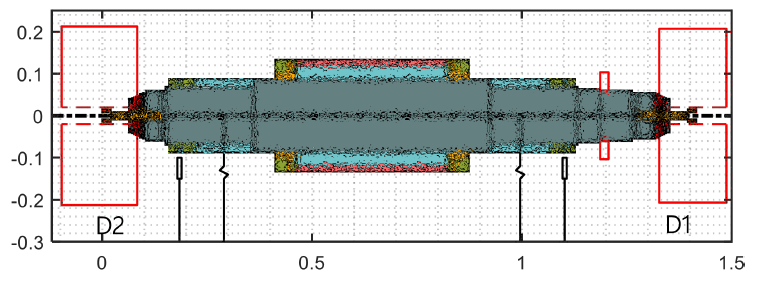
Figure 2. rotor model with bearing parts modelled as beam elements
Building on the beam-element model of the rotor and bearings, the next critical step is to analyze its dynamic behavior across the entire operating range. This is where the Campbell diagram becomes an indispensable tool.
Following the establishment of our model, we perform a modal analysis to identify the system’s free-free modes, extracting the natural frequencies and mode shapes of the flexible rotor. This gives us the foundational understanding of how the rotor wants to vibrate independently.
We then extend this analysis into a full rotordynamics simulation to create the Campbell diagram, which plots the system’s natural frequencies against rotational speed. This allows us to visually identify critical speeds—where excitation orders (like the 1X synchronous line) intersect with these natural frequencies, indicating potential resonance points.
An example output from our feasibility study is presented in the figure below:
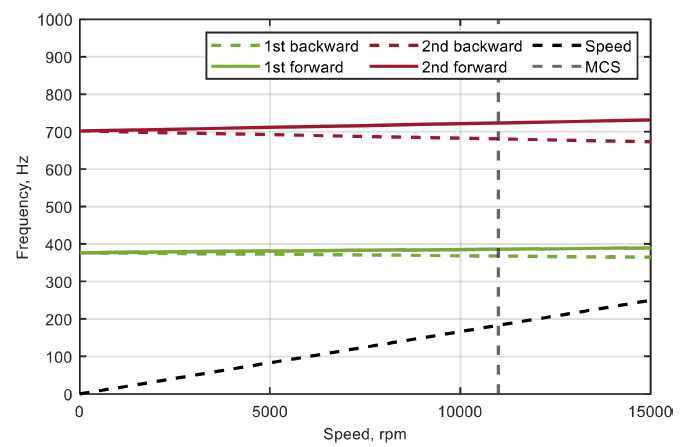
Figure 3. Campbell diagram for system modelled with beam elements
What our expert says about the feasibility study
“The preliminary design stage is undoubtedly one of the most dynamic and engaging phases of any engineering project. It’s here that our team has the opportunity to blend creativity with technical rigor—translating customer needs, industry standards, and production realities into tangible design concepts. During this stage, we typically develop several competing design approaches, each exploring different approaches, and assembly processes.
What makes this phase so powerful is the collaboration it inspires. Through spirited internal discussion and close consultation with the customer, we evaluate each concept and converge on the most effective solution—one that balances performance, reliability, and manufacturability.
At SpinDrive, we firmly believe that a thoughtful and thorough preliminary design sets the foundation for project success. It’s more than just a step in the process; it’s where vision takes shape and innovation begins to turn into reality.” says Oleg Kyrmyzy, Lead Mechanical Engineer at SpinDrive.
Are you interested in getting a feasibility study for your application? Contact us and get a free feasibility study report sample.
Other blogs about active magnetic bearings
Interested in learning more about active magnetic bearings? Check other blogs about active magnetic bearing applications in various industries:
Active magnetic bearings for turbo blowers
Active magnetic bearings for turbo compressors
Active magnetic bearings for high-speed spindles
Why Magnetic bearings for high-speed applications?
Applications of active magnetic bearings
Benefits of active magnetic bearings

Author: Ole Martola