Unlocking the Full Potential of Flywheels with Active Magnetic Bearings

Flywheel energy storage systems (FESS) are becoming one of the key solutions for efficient and reliable energy management across various industries. They work by converting electrical energy into kinetic energy and vice versa when discharging, offering virtually unlimited charge-discharge cycles with no battery degradation. One of the biggest advantages of flywheels is their rapid response time, making them ideal for stabilizing short peak loads on the grid while allowing energy to be recharged over a longer period.
Due to these benefits, flywheels are widely used in renewable energy integration, railway systems, aerospace, and data centers to provide instant energy buffering and load balancing. Their ability to deliver high-efficiency power discharge and a long lifecycle makes them essential for modern energy storage applications. However, to fully unlock their potential, one critical component must be optimized—the bearing system.

Flywheel energy storage system manufactured by Teraloop
Traditional bearings, such as ball or roller bearings, are widely used in rotating machinery, but when applied to flywheels, they introduce several challenges that limit performance. Let’s explore these challenges in more detail and see how they can be overcome.
Challenges of Traditional Bearings in Flywheel Systems
The efficiency and longevity of flywheels depend largely on their bearing system. Traditional mechanical bearings come with inherent limitations that can impact the performance of a flywheel system:
- Friction and Wear – Conventional ball or roller bearings experience continuous mechanical contact, leading to friction losses, heat generation, and material wear over time. This not only reduces efficiency but also shortens the system’s lifespan.
2. Maintenance and Downtime – Due to mechanical wear, traditional bearings require continuous lubrication and frequent replacement. This adds to maintenance costs and can result in unexpected downtime, disrupting system operation.
3. Energy Losses – The friction generated in mechanical bearings translates into energy dissipation, making the flywheel less efficient in storing and releasing energy.
4. Limited Rotational Speeds – Traditional bearings impose speed limits because of excessive heat and mechanical stress. The faster a flywheel rotates, the more stress is placed on the bearings, ultimately capping the system’s potential energy storage.
5. Vibration and Noise – Mechanical contact in ball and roller bearings generates vibration and operational noise, which can limit the system’s usability and lead to system instability and additional energy losses.
6. Lubrication – many times flywheel operate in vacuum to increase the energy efficiency. Lubricated ball bearings, air bearings and fluid film bearings require some intermediate medium e.g. oil, grease or air for operation and they cannot operate in vacuum.
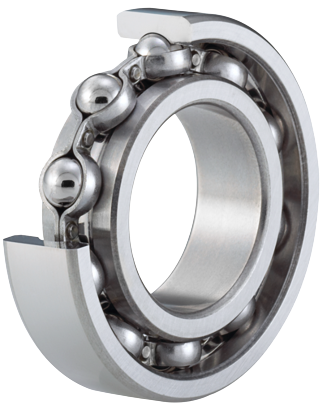
Ball bearing manufactured by GMN
To fully utilize flywheel technology, a better bearing solution is needed—one that minimizes energy losses, reduces maintenance, and allows for higher speeds. This is where Active Magnetic Bearings (AMBs) offer a revolutionary alternative.
Active Magnetic Bearings are a transformative technology that overcomes the limitations of traditional bearings. Instead of relying on physical contact, AMBs use electromagnetic forces to suspend and control the rotor in mid-air. This eliminates mechanical friction and enables a range of benefits that directly address the challenges faced by flywheels.
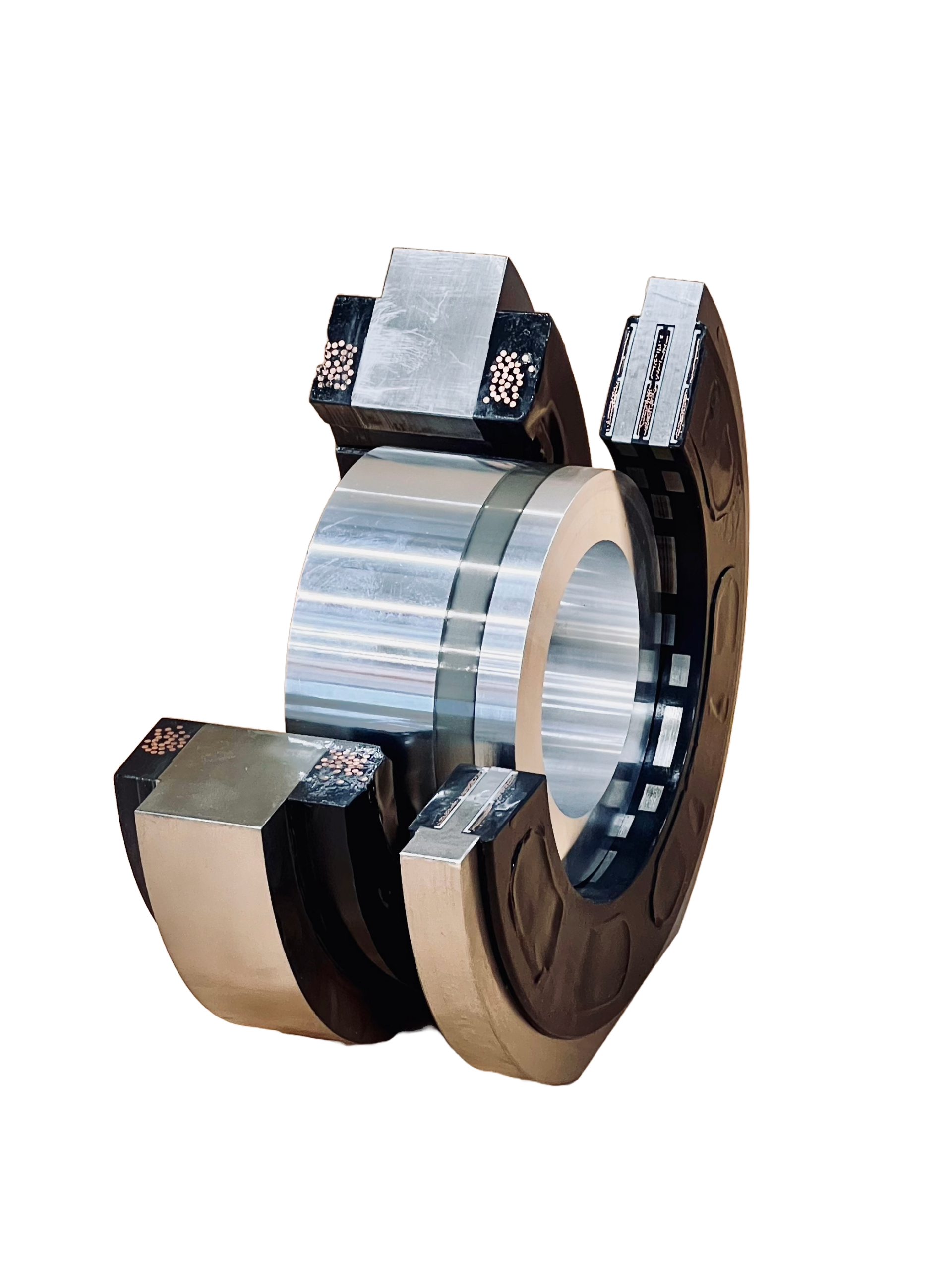
Active magnetic bearing manufactured by SpinDrive
How AMBs Solve Flywheel Challenges
Let’s take a closer look at how AMBs provide an optimal solution for flywheels:
- Elimination of Friction and Wear. Since AMBs operate without physical contact, there is no mechanical wear. This significantly extends the system’s lifespan and enhances reliability.
- Minimal Maintenance Requirements. Unlike traditional bearings that require continuous lubrication and frequent part replacements, AMBs are virtually maintenance-free, and no lubrication is needed. This leads to lower operational costs and less downtime.
- Higher Efficiency. With no frictional losses, AMBs maximize energy retention and improve the overall efficiency of the flywheel system, making energy storage more effective.
- Higher Rotational Speeds. AMBs allow flywheels to operate at extremely high speeds only constrained by mechanical stress of the rotor materials. This enables more compact and powerful energy storage solutions.
- Active Control and Stability. AMBs incorporate advanced sensors and control algorithms that adjust rotor positioning in real time. This enhances system stability and minimizes unwanted vibrations.
- Silent Operation. The contact-free nature of AMBs results in virtually noiseless performance, making them ideal for applications where quiet operation is essential.
- Fully functional in vacuum. AMBs operate without lubrication, keeping distance between the rotating and stationary parts. The magnetic field is not influenced by vacuum, and AMBs can operate in vacuum without any special arrangements.
The future of flywheel technology
Flywheel energy storage systems have immense potential, but traditional bearing technology has often been a limiting factor. Active Magnetic Bearings (AMBs) provide a frictionless, maintenance-free, and highly efficient alternative, allowing flywheels to achieve optimal performance.
By eliminating mechanical constraints, AMBs unlock higher efficiency, longer lifespan, and greater operational stability. As industries continue to seek innovative energy storage solutions, AMBs are paving the way for the future of flywheel technology.
At SpinDrive we have a deep understanding of flywheel technology and have been supplying AMBs for flywheel systems for years.
Are you ready to explore how AMBs can transform your flywheel applications? Reach out to us today to learn more!
About the author
SpinDrive CEO, Janne Heikkinen holds a doctoral degree from mechanical engineering. In his doctoral studies, he explored the effect of geometric inaccuracies of bearings to the vibrations of rotors.

Author: Janne Heikkinen
Click the links to learn more about additional topics:
Why Magnetic bearings for high-speed applications?
Applications of active magnetic bearings
Benefits of active magnetic bearings
Customized design for active magnetic bearings