What is an Active Magnetic Bearing (AMB)?

An Active Magnetic Bearing (AMB) is a type of contactless and frictionless bearing. It uses actively controlled magnetic forces to achieve levitation. By levitating the rotor, there is no contact between the rotating and stationary parts.
Working principle of Active Magnetic Bearings
The suspended rotor is magnetically levitated, and its position is monitored and controlled by the AMB system. The electromagnetic field generated by the AMB system is used to support the rotor, while the control system monitors and adjusts the force exerted by the electromagnets to ensure that the rotor is held in a stable position. This enables fast, precise rotation with minimal friction, energy losses and wear.
Great potential for industrial applications
Existing high-speed electric motor solutions are inefficient and costly to maintain. Electricity and maintenance costs represent more than 70% of their total lifecycle costs. These electric motors are the largest electrical end users, accounting for approximately 45% of global electricity consumption.
Industrial electric motors operate at high speeds of above 10,000 rpm. Hence, they are often subject to failures and breakdowns, which then compromise the productivity and efficiency of the entire system they drive.
Active Magnetic Bearings (AMBs) are the solution to this problem. Our mission is to provide frictionless Active Magnetic Bearings for high-speed electric motors, thereby reducing electric motor system failures, maintenance and electricity costs.
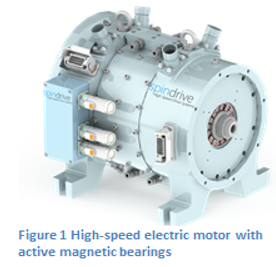
High-speed electric motors with magnetic bearings are attracting increasing attention across different industrial sectors. The reason for their deployment varies considerably. Key driver include improving efficiency to conserving energy and reduce environmental pollution, increasing power density, enhancing functionality and improving reliability and maintainability are some of the key driving factors.
Yet, in new and more demanding industrial applications, ranging from distributed power generation to energy storage, electric vehicles and industrial manufacturing, high-speed motors still facing a wide range of challenges.
Magnetic bearings levitate the rotating system
Magnetic bearings rely on levitation – the process by which an object is suspended without mechanical support. The supporting forces can originate from several sources. When the forces are produced by a magnetic field, the process is referred to as magnetic levitation.
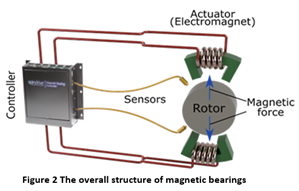
Levitation occurs when two magnets (magnetic bearings) pull the body – in the case of an electric motor, the rotor – toward each other. For this, the magnets are placed on opposite sides.
A set of sensors continuously measures the position of the rotor. Knowing the exact rotor position, the magnetic bearing controller can estimate how much force is required from each magnet to keep the rotor centered.
The sensors measure the rotor position up to 100,000 times per second and can detect any subtle changes in the system. They provide additional information and insights into both the electric motor and process in which it operates.
Instead of permanent magnets, AMBs use electromagnets, as they allow the force to be adjusting by changing the current in coils.
Figure 2 illustrates the main principle of a rotor system levitated by magnetic bearings without any contact.
Magnetic bearings replace traditional bearings in rotating machinery and do not require any other media (fluid or gas) for its operation, thus eliminating the need for lubricants.
The absence of mechanical contact removes the friction and the associated losses, allowing high-speed electric motors with magnetic bearings to be more energy efficient. As stationary and rotating parts do not touch each other, there is no component wear. Magnetic bearings provide all these benefits.
Evolution of magnetic bearing technology
The principles of magnetic bearing technology have been known for decades. Initially, the technology consisted of a fully analog system with bulky power amplifiers and an unreliable control system built on inductive and capacitive elements. This significantly limited the applicability of the technology to only aerospace and military projects that could afford such complexity.
The second generation emerged with advancements in the computer industry when digital control systems replaced the analog ones. The growth of computation power provided sufficient capacity to calculate control signals in real-time for the levitated body in real time. Digital controllers improved reliability and made tuning easier.
The next breakthrough came when switching power amplifiers appeared on the market. Combined with digital control, the third generation of magnetic bearings appeared with modern power amplifiers that are compact and fast. That was the moment when the industry began adopting technology on a wider scale.
Today, the next generation of controllers is ready to hit the market. These will bring significantly more computing power, allowing more advanced control. A fast connection to the cloud environment will make it possible to process large amounts of data and extract valuable information from the collected data. With all this intelligence onboard, the magnetic bearing system is able to adapt to the most challenging situations, provide automatic tuning and commissioning and assess the health of the rotating body and and the associated process.

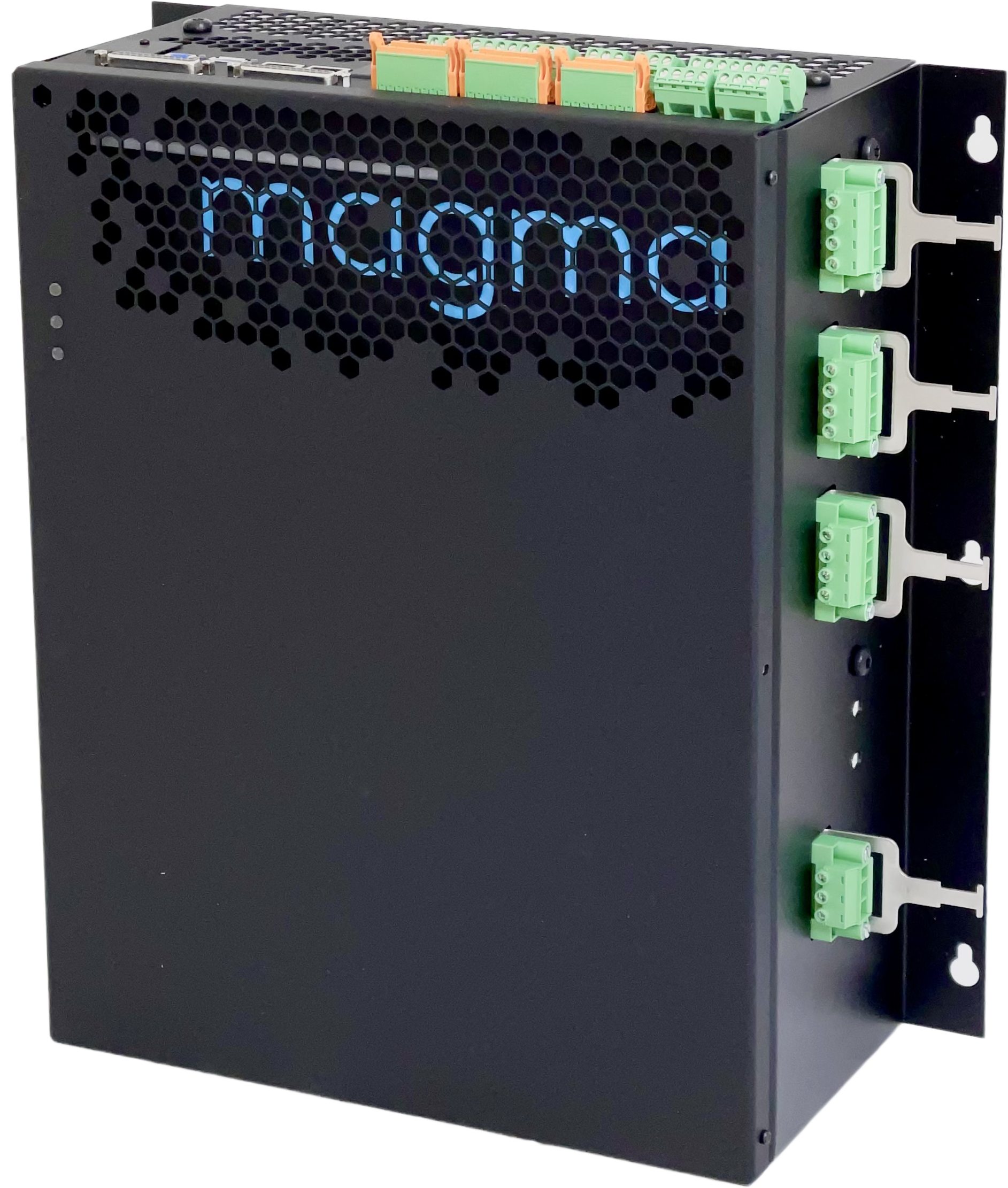
Figure 3. Magma®, SpinDrive’s new-generation magnetic bearing controller
Benefits of magnetic bearings
Active Magnetic Bearings eliminate friction losses, resulting in higher overall mechanical and energy efficiency. This allows original equipment manufacturers to meet the demands of increasingly power-intensive applications while reducing energy losses and CO2 emissions.
Magnetic bearing technology is a game-changing solution in which there is no contact between the rotating and stationary parts of the machinery. This means there is no mechanical wear, resulting in a minimal risk of failure. Consequently, there is a minimal need for scheduled maintenance and unplanned downtime affecting the enduser’s entire production process.
In addition, magnetic bearings are suitable for applications and environments that are sensitive to machine vibrations. They also help minimize noise from the process or electric motor itself.
Typical applications
AMBs are used in a wide range of applications. Learn more about typical magnetic bearing applications from our Applications page: Applications – SpinDrive – Easy integration across industries
Why are Active Magnetic Bearings the bearings of the future?
Industrial electric motors are the largest end users of electricity. There are about 8 billion electric motors in the European Union, consuming around half of the electricity the EU produces. The existing solutions for high-speed electric motors are inefficient and expensive to maintain. More than 70% of their total lifecycle costs are for electricity and maintenance.
Active Magnetic Bearings (AMBs) are the solution to this problem. Industrial electric motors operate at high speeds of over 10,000 rpm. As a result, they are often subject to failures and breakdowns that can affect the productivity and efficiency of the entire system they drive.
High-speed electric motors with magnetic bearings are attracting more and more attention in a wide range of industrial sectors. The motivation for using them varies considerably:
- The need for efficiency improvements, and thereby, energy savings and environmental reductions.
- Power density enhancement, improved functionality, reliability and maintainability are also key drivers.
However, in the context of new and more demanding industrial applications, ranging from distributed power generation and energy storage to electric vehicles and industrial manufacturing processes, high-speed motors still face a number of challenges.
SpinDrive mission
We are dedicated to making frictionless active magnetic bearings accessible and affordable for high-speed electric motors. This helps reduce system failures and lower maintenance and electricity costs.
Click the links to learn more about additional topics:
Applications of active magnetic bearings